
I came across an essay I wrote in Uni on one of my all time favourite movies, Blade Runner. The movie, with its underlying themes, is as relevant today as it was back then. I’ve posted it below (sans the footnotes).
We gaze from an elevated distance; below us a sprawling urban jungle, with monstrous skyscrapers reaching wretchedly to a sun that never penetrates the acid tinged rain falling endlessly on its inhabitants. Great smoke stacks belch forth flames and we are assaulted with images of urban decay, mass consumerism, mass advertisement, a post-industrialism of the worst kind. It is the year 2019 and this is Los Angeles, the setting for Ridley Scott’s Blade Runner.
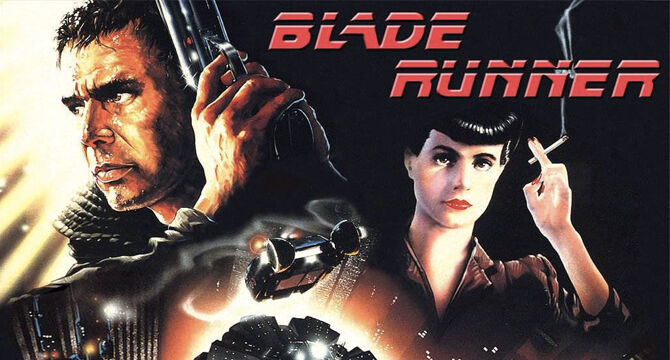
Blade Runner is a contemplation of what life will be like in the future; morally, technologically and politically, and the dystopian world that it posits is an echo of our future discontents. It is a postmodern pastiche of the science-fiction genre, the hard-boiled private eye detective genre and the horror genre, dealing implicitly with the anxieties of postmodernity; the nature of reality and simulacrum in a world governed by corporate capitalism and huge screen television the nature of humanity in the world of technology, and the apprehensions that beset present day society. It also acts as a satire on our society with its excessive consumption and waste, a mirror of post-World War II mass consumerism; and the Cold War paranoia (an obvious reality) of nuclear war is apparent in Blade Runner’s ecocidal landscape. Contentious issues such as abortion, animal rights and racism are represented in the dialectics surrounding Deckard and the Replicants (who are essentially fighting for the right to live) that he has to ‘retire’.
What does it mean to be human?
This philosophical question and the ambiguities it raises is one of the central themes of Blade Runner. Made for Man, by Man, the Nexus-6 had a shelf life of four years and perhaps the only thing differentiating them from the rest of humanity is the fact that they were not born of human egg and sperm. Blade Runner presents these replicants as possessing traits of humanity that by far outweigh any of the humans in the film, Deckard himself being referred to by his ex-wife as, ‘sushi…cold fish’. We are told in Deckard’s Chandleresque narration that ‘Replicants weren’t supposed to have feelings’, yet it is through the Replicants and their noble fight for a meaningful life that our deepest emotions are touched. The tears that spill down Rachel’s face as she discovers that she is a replicant are very real and the camera portrays her as being essentially ‘human’. We watch the close-ups; reflecting upon Rachel’s perfectly made up face, the ‘tremors of emotional dawning’, and it is through Rachel that we see the film’s ‘most delicate embodiment of frail humanity struggling for re-emergence’ . At the opposite end of the spectrum is Roy Batty, the leader of the rebellious replicants. The ultimate Aryan superman whose vitality and passion for life makes him essentially ‘more human than human’. It is Roy who expresses fundamentally human characteristics; Revenge of a Shakespearian quality as Roy murders his ‘maker’, his face contorting with rage and pain; grief over the death of his lover Pris, fully vented with each wolf owl of agonising pain; irony as he says to Chou, “If only you could see what I’ve seen with your eyes”, and underlying all this is the keen awareness of mortality. It is with this tragic Promethean hero that we empathise. In the short time they have to live, the replicants develop an awareness of their full potentiality and with this comes the knowledge of their impending death. We feel the pain that Roy feels as he realises all the things that he will never be able to do, all his accomplishments that will never come into fruition, future experiences made obsolete when he killed his creator, Dr Eldon Tyrell. The emotion we feel, ‘a profound sense of loss of potentiality’ is akin to the one that accompanies the death of young children, for in essence Roy and his friends were in fact children, still developing and maturing their sense of identity and self. As he saves Deckard from plunging to his death, just moments before his own death, Roy is in fact saving the one part of himself that is truly human , his empathy for others, non-human and human illustrated in that selfless act. And as he bids adieu to the world that loved him not, the pathos and eloquence of his lyrical words will resound forever in our heats as the most profound moment of Blade Runner;
I’ve seen things you people wouldn’t believe,
Attack ships on fire off the shoulder of Orion.
I watched c-beams glitter in the dark near the Tanhauser Gate…
All these moments will be lost in time, like tears in rain…
Time to die.
The value of life as something precious, something that cannot be, must not be, wantonly commodified, is mirrored in these replicants. They serve as a critique for people, ‘by allowing examination and moral scrutiny of ourselves, our technology, and our treatment of other beings, and by defining in their tragic struggle what is truly human.’
Biblical and literary metaphors abound throughout the film. Roy’s enigmatic lines to Chou;
Fiery the Angels fell, Deep thunder roll’d around their shores,
Burning with the fires of Orc.
paraphrases William Blake’s, ‘America: A Prophesy’;
Fiery the Angels rose, and as they rose deep thunder roll’d
Around their shores; Indignant burning with the fires of Orc.
and establishes the replicants as fallen angels. Their banishment from Earth parallels that of the Edenic legend and of Milton’s, Paradise Lost, with Roy being at once Satan and Christ. Like Mary Shelley’s Frankenstein, Roy as the Prodigal Son ascends the pyramid structure of the Tyrell Corporation (its structure is that of the Mayan Temple of the Sun reminding us of human sacrifices) to meet his maker, ‘the God of Biomechanics’. It is in the chambers of Tyrell’s opulent bedroom , as he argues with his maker for ‘more life’ that we begin to see the first signs of Roy’s inner moral conflict over the ‘questionable things’ he has done. And after he kills the only men who can save him we can only wonder what Roy’s thoughts are as he gazes in silence at the stars above. As he clenches his fist Roy is aware that the numbness is a sign of death (unlike Frankenstein whose fist clenching is a sign of life) and so drives a nail through his hand, an act symbolic of Christian crucifixion. Just as Man’s ’felix culpa’, fortunate fall, is occasioned by Satan so too is Roy the cause of Deckard’s fall and like Christ, he redeems him in the end not only from his literal death but by giving Deckard the most precious part of humanity, love for life and all things loving. As Deckard sits there in the rain across from the being that saved his life, the being he was meant to ‘retire’ we see his humanity reflected in the tears in his eyes, in his comprehension as he watches Roy die;
All he’d wanted were the same answers the rest of us want:
Where do I come from? Where am I going? How long have I got?
It is as much a story of Deckard regaining his own humanity, expressed in his doubts about himself; “What the hell was happening to me?”, and his function as a blade runner whose had “a belly full of killing” and finally developing empathy for living beings, much like Coleridge’s Ancient Mariner.
In an environment which fosters the dehumanisation of its inhabitants, Blade Runner, with its visual/narrative tonalities of despair is ‘a metaphor for our post modern condition’. At first glance Blade Runner’s , “and they all lived happily every after” ending seems to contradict the whole film; Deckard and Rachel escaping the dystopia of Los Angeles into a pristine, magical landscape akin to Eden itself while we’re told by Deckard/Raymond Chandler that Rachel has no termination date, Hollywood nostalgia rearing its head again. Yet by the same token, this film deals with the nature of redemption, the desire for other alternatives, a utopian fantasy that acts, “not to neutralise the force of the social criticism, but to intensify it, leaving us more or less suspended between the intolerable conditions exposed in the films and our desire for more adequate solutions”. Rachel and Deckard’s escape is a rejection and resistance to violence, to the intolerable conditions projected in the film, and like Roy they are fighting against a corrupt system that would make slaves of them, shackled by fear. Blade Runner can then be read: “in terms of the utopian dialectic that combines social criticism with wishful thinking in order to arouse the desire for some kind of alternative.”
I could write volume upon volume about Blade Runner, waxing lyrical with every new gem unearthed and the brilliance of Blade Runner lies in its inexhaustible supply of , shall I say, “moment’ that will never be lost in time.
By Mai Chi Tran
#Bladerunner#humancondition#humanity#artificialintelligence#postmodernlife


